
Ask five NDIS guides what transport funding costs and you’ll get five different numbers. Most of them are answering two questions at once without saying so. One pot of money lands in your account each fortnight for taxis and rideshare. A different pot pays a support worker to drive you somewhere. Mixing them up is the main reason South-West participants either under-claim or open an invoice that makes no sense.
The short version: NDIS transport funding, also called Transport Allowance, is a fixed yearly payment for participants who can’t use public transport independently. It pays at one of three levels, from $1,784 to $3,456 a year, depending on how much you work, study or attend day programs. Assist Travel/Transport is a separate support, and that’s where the real cost detail sits.
What Are the Three Levels of NDIS Transport Funding?
Your level depends on your work, study and community participation. Not your postcode.
| Level | Who it’s for | Annual amount |
| Level 1 | Not working, studying or attending day programs, but wants more community access | $1,784 |
| Level 2 | Working or studying part-time, up to 15 hours a week, or attending day programs | $2,676 |
| Level 3 | Working or studying at least 15 hours a week | $3,456 |
Under the NDIA’s PACE system this sits in your Recurring supports budget as Recurring Transport. Older plans may still label it Support Category 02. Either way, the money is paid fortnightly straight into your bank account, and you don’t lodge claims for it.
It’s a stated support, so it can only go toward transport. You can’t shift it into support worker hours, and it won’t reimburse fuel receipts. Taxis, rideshare and public transport fares are what it’s for.
The NDIA reviews these amounts, so check your own plan document for the figures that apply to you.
Transport Allowance vs Assist Travel/Transport: What’s the Difference?
Most guides go vague here, and it’s the part that decides what you actually pay.
| Transport Allowance | Assist Travel/Transport | |
|---|---|---|
| What it is | Fixed yearly payment | Core support, billed by the hour |
| Who gets the money | Paid to you | Paid to your provider |
| What it covers | Taxis, rideshare, public transport | A support worker driving or travelling with you |
| How it’s costed | $1,784 to $3,456 a year | $73.58/hr weekday, plus $0.99/km, plus travel time |
| Where it sits | Recurring supports | Core budget |
Those hourly and kilometre figures come from the NDIS Pricing Arrangements and Price Limits for 2026-27, which took effect on 1 July 2026. A modified vehicle attracts up to $2.76 per kilometre. Providers can also claim travel time to reach you, capped at 30 minutes in MMM1-3 areas and 60 minutes in MMM4-5 areas, based on where you are when the support is delivered. Check your service agreement, since providers set their own rates within those limits.
So a support worker taking you to a specialist appointment doesn’t touch your Transport Allowance at all. That’s Core budget, billed like any other support session. For the fuller picture of what the service covers and whether you’re eligible, see our guide to how assist travel and transport support works.
What Does Transport Actually Cost Here?
Take a real scenario. A participant in Dalyellup needs a support worker to drive them to a medical appointment in Bunbury. Dalyellup sits roughly 11 kilometres from the Bunbury CBD, so that’s about a 22-kilometre round trip, plus 45 minutes of support at the appointment.
That session draws on Assist Travel/Transport: 45 minutes of support time at the weekday rate, the kilometre charge for the return trip, and any allowable travel time for the worker to reach them. On the 2026-27 limits, the support time works out at about $55 (45 minutes at $73.58), with roughly $22 in kilometre charges on top (22 km at $0.99), before any travel time. None of it comes out of the Transport Allowance.
That same participant catching a rideshare into Bunbury on a Saturday to see friends? That trip comes out of the $1,784 to $3,456 allowance instead. Different pot, different rules.
Distances bite harder here than in Perth. A run from Eaton or Gelorup into central Bunbury, or out to Donnybrook for a specialist, racks up kilometres fast, and those kilometre charges are billed on top of support time rather than absorbed into it. Ask your provider how they calculate travel on longer country trips before you agree to a regular booking.
How Does WA’s Passenger Transport Subsidy Scheme Stack With Your Plan?
Still working off the old Taxi User Subsidy Scheme? It’s gone. The Passenger Transport Subsidy Scheme (PTSS) replaced TUSS from 1 March 2025, and since 1 October 2025 the old paper vouchers no longer work anywhere. PTSS runs on a smart card instead.
The standard PTSS subsidy covers 50% of an eligible taxi fare. Participants eligible for the wheelchair-accessible subsidy get 50% or up to 75%, depending on their circumstances.
Here’s the part worth knowing: this state scheme sits alongside your NDIS Transport Allowance rather than replacing it. On a $40 taxi fare to a Bunbury appointment, a standard PTSS subsidy covers $20 and your transport funding can cover the rest. Plenty of South-West participants never applied after the TUSS switch, simply because nobody told them, and they’ve been paying full Transport Allowance for trips a state subsidy would have halved.
Applying is free. Check the Department of Transport’s PTSS page for eligibility.
What Doesn’t NDIS Transport Funding Cover?
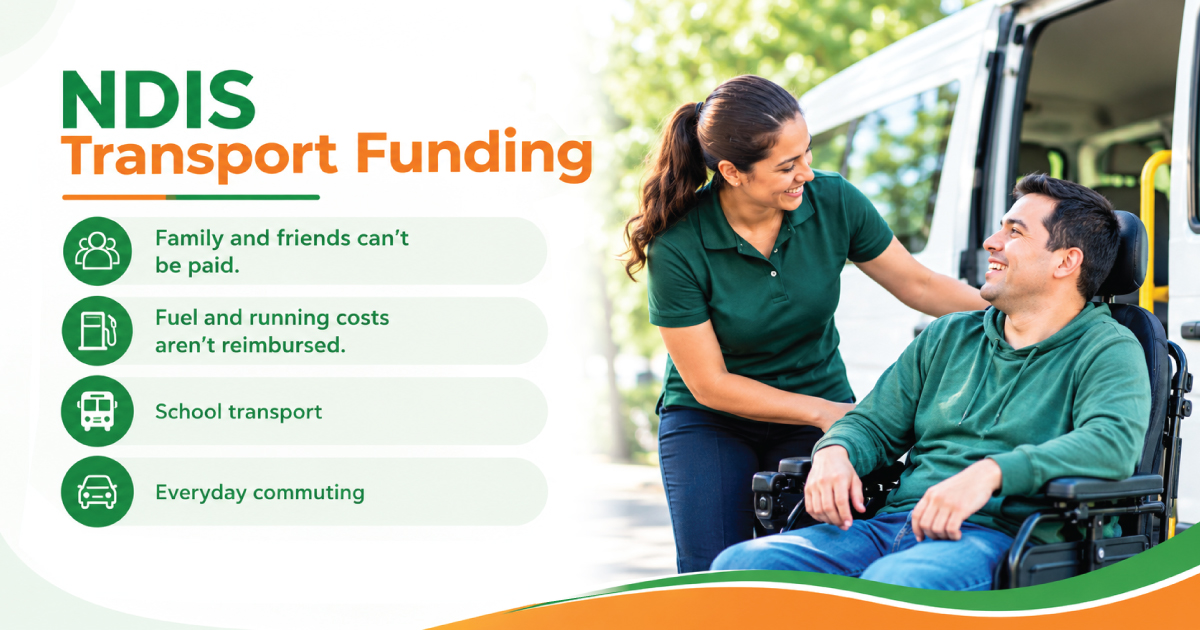
Four things catch people out at every plan review.
- Family and friends can’t be paid. Neither Transport Allowance nor Assist Travel/Transport pays an informal support, like a partner or parent, for driving you.
- Fuel and running costs aren’t reimbursed. Transport Allowance is a flat payment, not a receipts-based system.
- School transport generally sits with the education system, not your NDIS plan.
- Everyday commuting with no disability-related need isn’t the target. The test is whether your disability, not preference, stops you using public transport safely.
How Do You Get More Transport Funding?
Four options worth raising at your next plan review or check-in.
Ask about exceptional circumstances funding. The NDIA can approve above Level 3 where your costs genuinely exceed the standard levels. It’s uncommon and needs solid evidence, but regional distances are exactly the sort of argument it exists for.
Check how flexible your plan is. The way your funding is managed changes what you can move around. Our guide to plan-managed vs self-managed NDIS funding covers the trade-offs.
Apply for PTSS. Free, and it stacks with what you already get.
Review your goals. Transport funding ties to your goals around work, study and community access. Changed circumstances should mean a changed level. A support coordinator can help you make that case.
For how the wider budget fits together, start with understanding NDIS funding. Want to work out what level fits your week in the South-West? Get in touch with our team and we’ll walk through it. You can also see how our Assist Travel/Transport support works.
Frequently Asked Questions
What’s the difference between transport allowance and assist travel/transport?
Transport Allowance is a fixed yearly payment, $1,784 to $3,456 depending on your level, for your own taxi, rideshare or public transport use. Assist Travel/Transport is a separate Core support paying a support worker’s hourly rate plus a per-kilometre charge to drive or accompany you.
How much is NDIS transport funding in 2026?
Recurring transport pays at three levels: $1,784 a year if you’re not working or studying but want more community access, $2,676 if you work or study up to 15 hours a week, and $3,456 if you work or study at least 15 hours a week.
Can I use my taxi subsidy card with NDIS funding?
Yes. WA’s Passenger Transport Subsidy Scheme covers 50% of an eligible taxi fare as standard, or up to 75% for eligible wheelchair-accessible travel. Your NDIS Transport Allowance can cover the remainder. They’re separate schemes that work together.
Does NDIS transport funding cover fuel for a family member driving me?
No. The NDIS doesn’t fund informal supports, so neither Transport Allowance nor Assist Travel/Transport pays a family member or friend to drive you.
How is NDIS transport funding paid?
Under the NDIA’s PACE system, recurring transport is paid fortnightly straight into your nominated bank account. You don’t submit claims for it. It’s a stated support, so it can only be spent on transport.
What happens if my transport funding runs out?
Talk to your support coordinator before your next plan review. You may be able to show exceptional circumstances for extra funding, or find that a different level better matches your current work, study or community goals.
