Nothing happened to most NDIS plans on 1 October. That surprises a lot of people in Bunbury, Dalyellup and Eaton, who heard the cuts started that day.
The NDIS changes 2026 brought in are real, but they arrive plan by plan. Your community participation and daily living skills budgets change only when the NDIA creates, reassesses or renews your plan. Until then, your current plan keeps working as it did.
This guide covers what changed, when it reaches you, and what South-West participants can do about it now.
What Are the NDIS Changes in 2026?
The NDIS changes in 2026 come from the National Disability Insurance Scheme Amendment (Securing the NDIS for Future Generations) Act 2026. Parliament passed it on 19 August 2026 and the Governor-General signed it on 20 August.
For current participants, the biggest change began on 1 October 2026: a 50% cut to community participation budget allocations and a 10% cut to daily living skills allocations, applied plan by plan as plans are created, reassessed or renewed. The Government says that transition will take about 12 months.
The new NDIS laws don’t all start at once. They roll out across eight dates between August 2026 and July 2028, with some transition arrangements running to the end of 2030.
| Date | What changes | Who it affects |
|---|---|---|
| 27 August 2026 | New rules for asking for a plan reassessment, record keeping periods, stronger NDIA compliance and information powers, ministerial pricing powers, some automated decisions | Participants, nominees, plan managers, providers |
| 1 October 2026 | Funding reset for two support types begins on new and reassessed plans; the NDIA can suspend a plan where someone does not respond to information requests | Participants with affected budgets |
| 1 December 2026 | Claims must be made within 90 days of the support being delivered | Self-managed and plan-managed participants, providers |
| 1 February 2027 | Plan renewal replaces plan continuation; the funding reset also applies at renewal; unspent funds don’t carry over; new reasonable and necessary considerations | All participants at their plan date |
| 1 April 2027 | New framework planning begins, moving participants across in stages to 31 December 2030 | All participants, over time |
| 1 July 2027 | Mandatory registration expands for some higher-risk supports, including personal care and daily living | Providers, and participants who use them |
| 1 October 2027 | A commissioned panel of plan managers starts | Plan-managed participants |
| 1 January 2028 | New access process based on functional capacity; existing participants reassessed over three years | New applicants, then existing participants |
People with Disability Australia maintains the clearest plain-English version of this timeline in its guide to what the 2026 NDIS law changes mean. The NDIA’s own Securing the NDIS for future generations page carries the official announcement.
Which NDIS Supports Are Being Cut From October 2026?
Two support types are affected. You may see them called different names in your plan and in Government letters.
- Social, civic and community participation (also called assistance with social, economic and community participation): budget allocation reduced by 50%.
- Capacity building daily activities (also called improved daily living skills): budget allocation reduced by 10%.
The first is the budget most people use for community participation support: a support worker going with you to the gym, a club, the shops or a day out. That’s why the NDIS community participation funding changes are the ones South-West families ask us about most.
One point gets missed in a lot of coverage. People with Disability Australia notes that a 50% cut to the allocation doesn’t automatically mean 50% fewer hours. What you lose depends partly on how much of the old allocation you were actually using, and on how the budget interacts with the safeguards added by amendment.
Which Supports Are Protected?
The Government has said the cuts don’t apply to budgets for:
- supports in the home, including help with eating, drinking, dressing, toileting, laundry, cleaning, community nursing care and medication
- home and vehicle modifications
- personal mobility equipment and transport
- consumable products for needs such as incontinence and menstruation
- Specialist Disability Accommodation
- employment supports, disability-related health supports, high-intensity supports, complex behaviour supports, and some customised and wearable technology and hearing supports
So personal care, household tasks and transport budgets sit outside the reset. The NDIA checks your plan for protected supports itself when it applies the cut, and the Department says you don’t need to send extra evidence. Still worth knowing which of your supports are excluded, so you can check a new plan and ask questions if something looks wrong.
When Will the NDIS Changes From October 2026 Reach My Plan?
The changes reach your plan at one of three moments:
- You get a new plan on or after 1 October 2026.
- Your plan is reassessed on or after 1 October 2026, including a reassessment you asked for.
- Your plan is renewed on or after 1 February 2027.
Plans with affected funding that have not been created or reassessed since 1 October 2026 will be renewed by 30 September 2027, according to the Government. The NDIA says it will contact participants 60 days before a plan renewal.
A participant in Gelorup whose plan runs to May 2027 keeps their current community participation budget until then. Nothing in that plan shrinks in the meantime.
Worth knowing: a reassessment you request now can bring the cut forward. Weigh that up before asking for one, unless your support needs have changed enough to justify it.
What Changed With NDIS Plan Reassessment?
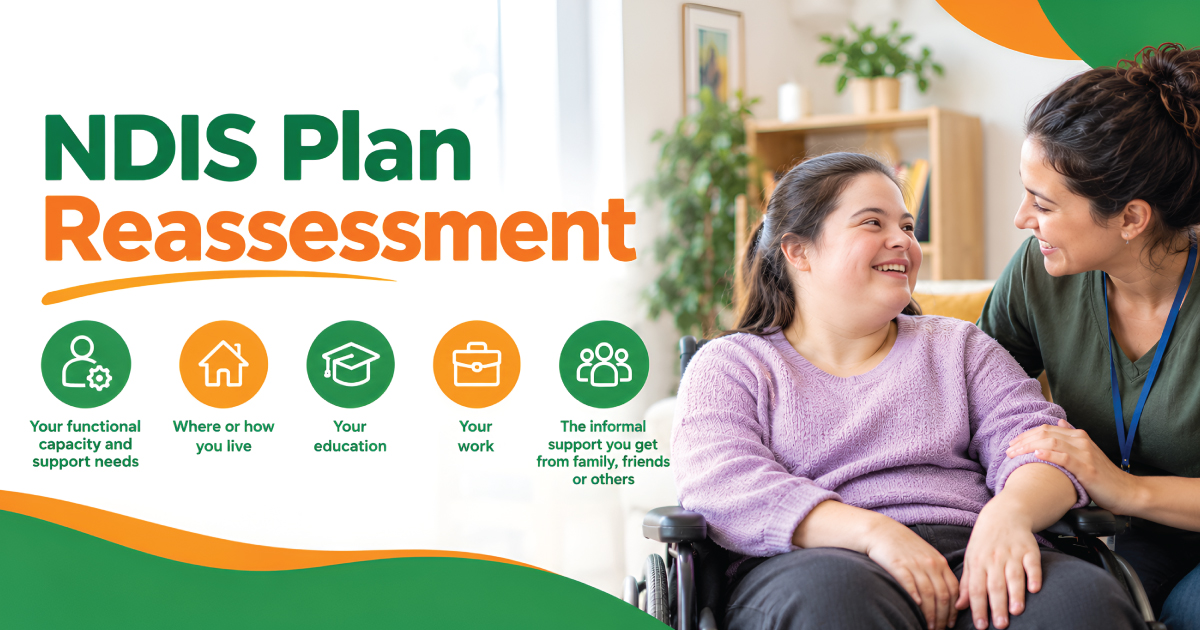
NDIS plan reassessment rules changed on 27 August 2026. Only you, your plan nominee or a child representative can now ask the NDIA for an unscheduled reassessment. Providers and support coordinators can’t request one on your behalf.
You can still ask when there’s a significant and ongoing change to:
- your functional capacity and support needs
- where or how you live
- your education
- your work
- the informal support you get from family, friends or others
The NDIA has 90 days to decide. No decision after 90 days counts as a refusal, which means you can use your review rights instead of waiting indefinitely. Emergencies, crises and short-term changes still go through a plan variation.
What Records Do NDIS Participants Need to Keep Now?
NDIS record keeping for participants is now a legal requirement, with set retention periods.
| Who | How long to keep records |
|---|---|
| Participants and plan managers | 3 years |
| Plan nominees | 5 years |
| Providers | 7 years |
The NDIA is still writing the detailed rules on exactly which records count. Keep invoices and service agreements, because you may need to show funding was used correctly.
Two safeguards are worth knowing. If the NDIA believes a debt exists, it has to tell you why and give you a chance to respond. And if you haven’t kept a record in the required format, you can still offer other evidence that the support was delivered.
From 1 December 2026, claims must also be made within 90 days of the support. That matters most for self-managed participants. Invoices left in a drawer for a few months won’t be payable any more.
A simple routine helps. This is our suggestion, not an NDIA requirement:
- Keep one folder, paper or digital, for each plan year.
- Save every invoice and service agreement, showing the date, the support, the provider’s ABN and the amount.
- Photograph paper receipts on the day you get them.
- Claim weekly or fortnightly, never in a quarterly batch.
Not sure which way of managing your plan suits these new rules? Our guide to plan-managed and self-managed NDIS funding covers the trade-offs.
What About Participants Who Need 24-Hour Support?
Participants who need disability support around the clock have an extra safeguard. Where the reset leaves you without enough funding to safely maintain 24-hour supports, you may be able to ask the NDIA for a plan variation.
To be eligible, you need NDIS-funded supports through the day and night for your disability-related needs, and at least $215,030 across specified support budgets before the cut is applied. You generally have 90 days from the reduction being applied to ask.
Be aware of the gap. The NDIA has up to 21 days to decide whether you qualify for this pathway, and up to another 21 days to decide on the variation. Any extra funding goes into Assistance with Daily Living or Home and Living supports. It does not restore the community participation money.
Families using supported independent living should diarise that 90-day window the day a new plan arrives. PWDA has flagged that current Government information doesn’t clearly explain whether interim funding is available while you wait, so raise an urgent gap with the NDIA and seek advocacy support straight away.
Do the NDIS Changes Work Differently in Western Australia?
No. The NDIS changes in Western Australia are the same as everywhere else, because the NDIS runs under one Commonwealth law. A participant in Dalyellup faces the same 50% and 10% resets as one in Sydney.
The effect on the ground still feels different here. In the South-West, a community outing usually means more travel than in a capital city. A trip from Donnybrook or Stratham into Bunbury eats into support hours before the activity even starts, so a halved budget may stretch less far than it would in a suburb with programs nearby.
Smaller towns also have fewer group programs, which often cost less per hour than one-to-one support. That makes an early planning conversation with your providers worth having.
Local help is available. Advocacy WA runs free, independent disability advocacy across the South-West from its head office at 4 Plaza Street, South Bunbury, seeing clients by appointment on (08) 9721 6444. The Disability Gateway (1800 643 787) can also connect you with an advocate, and the NDIA takes calls on 1800 800 110.
What Should South-West Participants Do Now?
Six practical steps, in order:
- Find your plan’s reassessment date. It’s in your plan and on the my NDIS portal. That date tells you roughly when the changes reach you.
- Check which budgets the reset affects. Look for community participation and daily living skills funding. Everything on the protected list above stays as it is.
- Talk to your providers about priorities. Work out which outings or skills goals matter most, so you’re ready if hours shrink.
- Set up your record keeping before December. The 90-day claims deadline starts on 1 December 2026.
- Read your new plan as soon as it lands. You have three months from the written decision to ask for an internal review if something looks wrong.
- Answer NDIA contact. Since 1 October the NDIA can suspend a plan where someone doesn’t respond adequately to requests for information after reasonable attempts to reach them. If the NDIA contacts you and you’re unsure what it’s about, ask them to explain in writing why they’re contacting you, what process is happening and whether there’s a deadline.
Want help working through your own plan? Our team supports participants across Bunbury, Dalyellup, Gelorup, Eaton and Donnybrook, including 24/7 care in your own home. Get in touch with Virtuous Care and we’ll go through what the reset means for your supports, line by line.
What Comes Next After the 2026 Changes?
The October reset is the first of several changes. From February 2027 the NDIA must weigh equity between participants, the sustainability of the scheme, and the circumstances of participants with similar needs when deciding what’s reasonable and necessary.
From July 2027, more providers of personal care and daily living supports must be registered, which makes the difference between registered and unregistered NDIS providers matter more. From October 2027, plan-managed participants will need to choose a plan manager from a commissioned panel, with six months to move across if their current one isn’t on it. From July 2028, support coordination moves to a commissioned model instead of coming out of your plan.
Much of the detail is still being written, including the record keeping rules, the new access assessment and the design of the plan manager panel. For the basics of how plan budgets fit together, see our explainer on how NDIS funding is structured.
Frequently Asked Questions
Did my NDIS plan get cut on 1 October 2026?
Probably not. The October 2026 funding reset applies only when your plan is created, reassessed or renewed on or after that date. Most current plans keep their existing budgets until their next plan date, and the Government is phasing the change in over about 12 months.
Are the new NDIS laws cutting personal care?
No. The new NDIS laws reduce two budgets only: social, civic and community participation by 50% and capacity building daily activities by 10%. Help with eating, dressing, toileting, cleaning, community nursing, medication, transport, consumables and Specialist Disability Accommodation are protected.
How long do NDIS participants need to keep records?
Participants and plan managers must keep records of supports and payments for three years. Plan nominees must keep them for five years and providers for seven. The NDIA is still finalising which records count, so keep invoices, receipts and service agreements.
Can I still ask for an NDIS plan reassessment?
Yes, as long as you, your nominee or a child representative makes the request. You need a significant and ongoing change in your support needs, living situation, work, education or informal supports. The NDIA has 90 days to decide, and a reassessment now will also apply the funding reset.
What can I do if I disagree with my new NDIS plan?
Ask the NDIA to explain the decision, then request an internal review within three months of receiving it in writing. A free disability advocate can help you prepare. Advocacy WA covers the South-West from South Bunbury, and the Disability Gateway on 1800 643 787 can connect you with other services.
Do the NDIS changes apply in Western Australia?
Yes. The NDIS runs under one Commonwealth law, so participants in Bunbury, Dalyellup, Gelorup and the rest of WA face the same changes on the same dates as participants in other states. The practical difference here is travel: longer distances can make a reduced community participation budget stretch less far.
Need a hand making sense of your plan? Talk to the Virtuous Care team about what the 2026 changes mean for your supports.
