
Your first NDIS plan approval is a big moment. But right after the relief comes a new question: who actually pays your providers, and how much of that work falls on you?
That’s where NDIS management types come in. Every NDIS participant chooses (or is assigned) one of three ways to manage their funding: self-managed, plan-managed, or agency-managed. These NDIS funding types matter because they directly affect your choice and control over the NDIS supports you receive.
This guide breaks down the plan-managed vs self-managed NDIS decision, plus the agency-managed option, in plain English, so you can make an informed choice at your next planning meeting. For a broader look at how NDIS funding works, see our NDIS info page.
The Three NDIS Management Options at a Glance
| Feature | Self-Managed | Plan-Managed | Agency-Managed |
|---|---|---|---|
| Who pays providers | You (then claim reimbursement) | Your plan manager | The NDIA directly |
| Provider choice | Registered and unregistered | Registered and unregistered | Registered only |
| Admin workload | Highest | Low | None |
| Extra funding needed | No | Yes, funded separately in your plan | No |
| Good for | Confident, organised participants who want full control | Participants who want provider choice without the admin | Participants who want a hands-off, simple option |
Self-Managed NDIS Funding
With self-management, you are in charge of your NDIS funding. You pay your providers, then claim the money back through the MyPlace participant portal. Most claims are paid within a few business days.
Self-management gives you the most choice. You can use both registered and unregistered providers, pick who supports you, and agree on prices and services that work for you.
You also carry the responsibility for managing that funding. This means you need to:
- Keep receipts and records.
- Track your spending.
- Make sure your purchases match your NDIS goals.
Self-management suits you if you’re comfortable managing money and paperwork, or if a trusted family member can help. Want less admin and more support? Plan management may be the better fit.
Plan-Managed NDIS Funding
Plan management sits in the middle, and it’s the most popular option for good reason. A registered NDIS plan manager pays your invoices and keeps your financial records for you, while you keep the freedom to choose your own providers, including unregistered ones.
Your plan includes funding for a plan manager as a separate item, so it doesn’t come out of your other support budgets. Plan manager services usually cover paying invoices, financial reporting on your spending, and keeping records ready in case of an audit. In practice, using a plan manager is often as simple as forwarding an invoice by email once a service has been delivered.
To find a plan manager, ask your NDIA planner or Local Area Coordinator at your planning meeting, or search directly for a registered plan manager in your area. Before you commit, check how quickly they process invoices and how clearly they report back on your spending, since this affects how well you can track your budget month to month.
This option suits participants who want the flexibility of choosing any provider, but don’t have the time, confidence, or capacity to manage invoices and record-keeping themselves.
Agency-Managed (NDIA-Managed) NDIS Funding
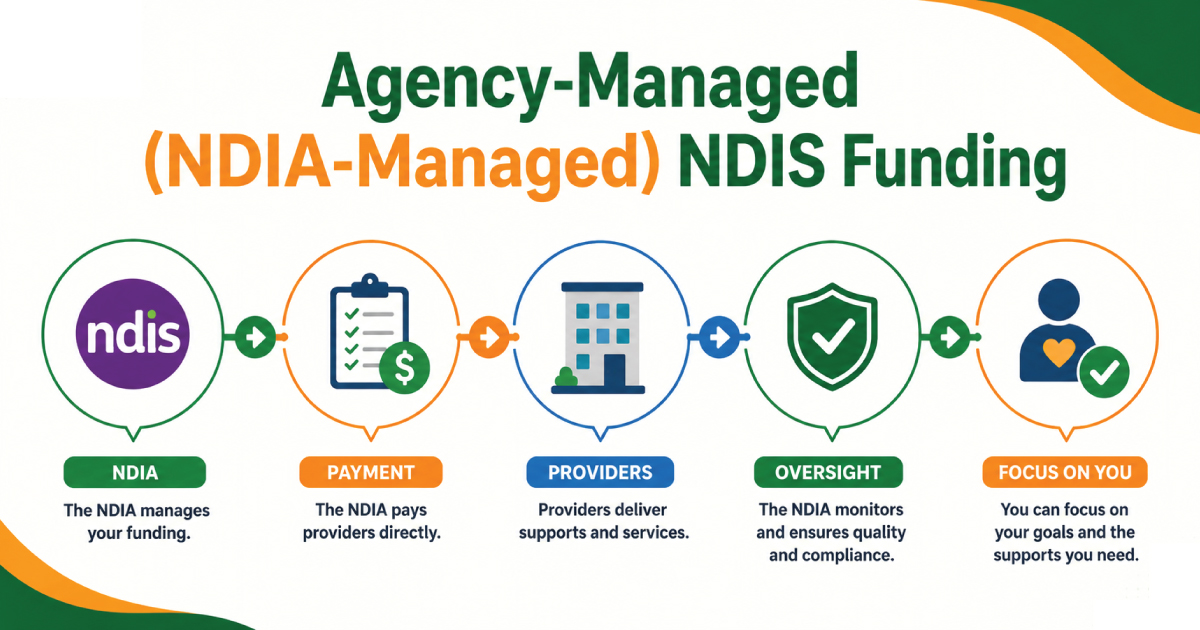
Agency-managed funding, also called NDIA-managed funding, is the simplest option to run. The National Disability Insurance Agency pays your providers directly, and you don’t see invoices or handle any paperwork at all. Don’t choose a management type? This is generally the default.
The catch is provider choice: you can only use NDIS-registered providers. For some participants, especially in regional areas, this can limit the pool of people available to support you.
This option suits participants who want a completely hands-off approach and are comfortable working only with registered providers.
Can You Mix Management Types?
Yes. Your plan doesn’t have to be managed the same way across the board. Different support categories can be managed differently. For example, you could have your core supports self-managed for maximum flexibility, while your capital supports are NDIA-managed. Many participants end up with some kind of mix once they understand how each option works in practice.
Have a support coordinator helping you set up your services? They can also explain how each management type interacts with the specific supports in your plan.
This flexibility matters when you compare providers for different services. Say you’re looking at personal care, community nursing, household tasks, social and community participation, assist travel and transport, or supported independent living. It’s worth checking whether the provider you want accepts your chosen management type, especially if you’re agency-managed and considering an unregistered provider. If accommodation supports are on your radar, our guide to SIL, STA and MTA explained covers how those options differ.
Can You Change Your Management Type Later?
Yes. You can change how your NDIS plan is managed at any time. You don’t have to wait for your next plan review.
Many people start with agency-managed funding because it’s simple and the NDIA pays providers directly. As they get more familiar with the NDIS, they often switch to plan-managed funding to access a wider choice of providers without taking on the paperwork themselves.
Not sure whether your current providers are registered? Our article on registered vs unregistered NDIS providers explains what that distinction actually means for you.
A Note on Upcoming NDIS Changes
The NDIS is going through a period of reform. The National Disability Insurance Scheme Amendment (Securing the NDIS for Future Generations) Bill 2026 was introduced to Parliament in May 2026, and among its proposed changes is a plan to commission a panel of vetted plan management providers, aimed at improving service quality and reducing fraud. As of mid-2026, this Bill was still under Senate committee review and had not yet passed into law, so nothing has changed for current plan-managed participants yet.
Given how often NDIS settings shift, it’s worth checking our NDIS funding changes in 2026 article and the NDIS’s own guide to management options for the most current information before you decide.
How to Decide Which Option Is Right for You
No single answer fits everyone, but these questions help:
- How much time can you realistically commit to admin, invoices, and record-keeping
- Do you want the option to use providers who aren’t NDIS-registered?
- Do you have a family member or support person who could help manage the paperwork?
- Are you new to the NDIS and want the simplest possible starting point?
Still unsure? Our article on how to choose the right NDIS provider and our broader guide to understanding NDIS funding are good next steps. Or get in touch with our team and we can talk through your situation.
Frequently Asked Questions
What’s the difference between self-managed, plan-managed, and agency-managed NDIS funding?
There are three ways to manage your NDIS funding:
Self-managed: You pay your providers and claim the money back from the NDIS.
Plan-managed: A plan manager pays your providers and keeps track of your payments for you.
Agency-managed: The NDIA pays your registered providers directly, so you don’t need to manage payments.
Can I use unregistered providers if I’m plan-managed?
Yes. If your plan is plan-managed, you can choose both registered and unregistered NDIS providers. This gives you more choice without the paperwork.
Does plan management cost extra?
No. Plan management is funded separately in your NDIS plan. It doesn’t reduce the budget for your other supports.
Can I use different management types in one NDIS plan?
Yes. You can choose different management options for different parts of your plan. For example, you can self-manage your Core Supports while the NDIA manages your Capital Supports.
Can I change my management type after my plan starts?
Yes. You can ask to change your management type at any time. You don’t have to wait until your next plan review.
Which NDIS management option is best for people new to the NDIS?
Many people find agency-managed funding the easiest, because the NDIA handles all payments. Later, plenty of participants switch to plan management to enjoy more provider choice while still having someone manage the paperwork.
Still Deciding? We’re Here to Help
How you manage your NDIS funding shouldn’t feel like a guessing game. Want to talk through your options, or ready to explore support with Virtuous Care Services? Submit a referral or contact our team. We’re happy to help you work out what fits your situation, whichever way your plan ends up being managed.
