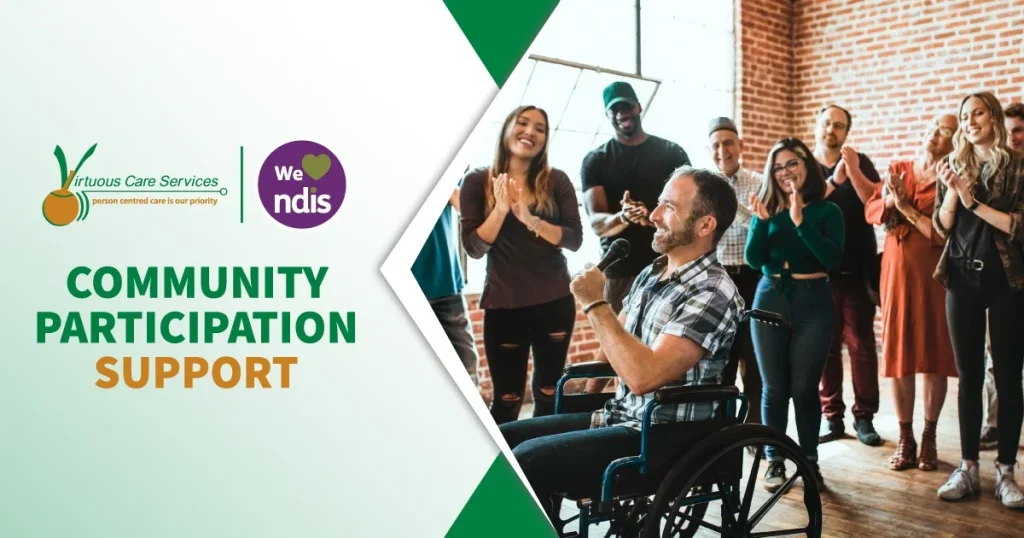
Community is an important part of life. It can mean your local area, your school, your club, your sports team, your neighbourhood group, or any place where people come together.
For many people living with disabilities, being part of the community is not always easy. There may be barriers like transport, access, money, fear, past bad experiences, or lack of support.
Some people may feel safer staying at home and not joining in.
But when the right support is in place, community participation can make a big, positive difference. It can help people feel more independent, more confident, and more in control of their own lives.
What Is Community Participation?
Community participation simply means being involved in everyday life outside your home. It is about taking part in activities, places, and groups where other people are.
Community participation can look different for everyone. For example, it might mean:
- Going to the local shops or market
- Joining a sports team or exercise group
- Attending a class, workshop, or hobby group
- Having coffee at a café with friends
- Volunteering at an op shop, charity, or community centre
- Joining a disability social group or peer group
- Attending community festivals, fairs, and events
It does not have to be something big or fancy. Even small steps like going for a walk in the park, talking to neighbours, or attending a local library program are forms of community participation.
Community participation is about connection. It is about being seen, being heard, and feeling like you belong somewhere.
Why Community Participation Matters
Human beings are social. We are not meant to live completely alone. We feel better when we have people to talk to, places to go, and things to do.
For people with disabilities, this is just as important – sometimes even more. When a person is isolated, they may feel lonely, bored, or forgotten. This can affect mood, sleep, appetite, and overall mental health. Over time, staying home all the time can reduce confidence and make the world feel scary or too hard.
Community participation gives people the chance to:
- Meet new people
- Make friends
- Learn new skills
- Discover interests and hobbies
- Feel part of something bigger than themselves
It is also a key part of living an independent life. True independence is not just about doing everything alone. It is about having choices, being involved in decisions, and being able to move through the world in your own way, at your own pace.
Community participation helps people practice these things in real life.
How Community Participation Builds Independence
Many people think independence means “doing everything by myself.” But that is not always true. Independence is really about having control, choice, and freedom in your daily life. You might still use supports, such as aged care, support workers, or assistive technology, but you get to decide how those supports are used.
Community participation plays an important role in empowering individuals to live with confidence and choice. It helps people stay connected to their local community, manage daily tasks, and feel more in control of their lives.
Making Choices in Real Life
When you go into the community, you make choices all the time. You decide where you want to go, what you want to do, who you want to talk to, and how long you want to stay. These choices often involve family friends, neighbours, and people you meet in your local area.
For example, you might choose:
- Which café to visit
- What to order from the menu
- Which club to join in your local community
- Whether to stay and chat or leave and rest
These may seem like small choices, but they are powerful. Each choice is a moment of control. Over time, making many small choices helps a person feel more independent and more in charge of their daily life.
Practising Everyday Skills
Community participation gives you chances to practise everyday and daily living skills in real situations.
You might practise:
- Using money to pay for things at the shop
- Reading signs and directions in your local community
- Using public transport, taxis, or assistive technology
- Asking staff for help or information
- Waiting in line
- Using a phone or app to check times and bookings
These skills are important for independent living and daily tasks. Learning them in real places, not just at home, makes them more meaningful and easier to remember.
Learning to Problem-Solve
Life in the community is not always perfect. Sometimes buses are late, shops are busy, or plans change. While this can be frustrating, it also creates chances to practise problem-solving in everyday life.
For example, if your bus is late, you may need to check the timetable, ask a driver a question, or plan a different route. If a family friend cancels a meet-up, you might decide to still go out or do something else you enjoy in your local community.
With the right support, including aged care services or assistive technology, you can learn how to handle these small problems. The more you practise, the more you learn that you can cope when things go wrong. This is a big part of independence and empowering individuals.
Managing Time and Routines
Being involved in the community also helps with time management and routines. If you decide to go to a weekly art class, cultural event, or sports group, you may start planning your week around it.
You learn to:
- Remember times and days
- Prepare what you need (for example, clothes, equipment, money, snacks)
- Be ready on time to leave the house
These are key independence and daily living skills that also help with work, study, aged care supports, and everyday tasks.

How Community Participation Builds Confidence
Confidence does not appear all at once. It grows slowly, step by step, through experience. Community participation is one of the best ways to grow real confidence and a strong sense of purpose.
Feeling Seen and Included
When you go out and take part in activities, you are not just sitting in the background. You are present. People see you, say hello, talk to you, and include you — whether they are neighbours, community members, or family friends.
This can feel very good, especially if you have spent a long time feeling invisible or ignored. Feeling included tells you, “I belong here too. I have a place in this local community.” This feeling builds self-worth, self-respect, and a sense of purpose.
We also acknowledge and pay our respects to Elders past and present, recognising the important role of Aboriginal and Torres Strait Islander peoples in our communities and shared spaces.
Trying New Things
Community participation often includes trying new activities — maybe a new sport, a new class, a cultural program, or a community group. At first, this can feel scary or uncomfortable.
But with gentle support, aged care services, or assistive technology where needed, you can take small steps. You might go and watch the group once, then join in for a short time the next week.
Every time you try something new, you prove to yourself, “I can do this. I can cope.” That is how confidence grows and how individuals feel empowered in their daily lives.
Building Social Skills
Confidence is also linked to social skills — knowing how to say hello, how to start a conversation, how to listen, and how to end a chat politely.
These skills can be practised during community activities in your local community. For example, you might learn how to:
- Introduce yourself to someone new
- Ask simple questions
- Join a group discussion
- Say “no” when needed
- Thank someone for their help
As you practise and see that people respond kindly, social situations feel less scary. You start to believe more in yourself and your ability to connect with others.
Achieving Personal Goals
Many people have goals connected to community participation, such as:
- Joining a sports team
- Going to the gym regularly
- Starting a hobby group
- Volunteering once a week
- Finding a part-time job
When you reach a goal like this, it can feel amazing. You can look back and see how far you have come in your daily life. This sense of achievement builds confidence, independence, and a strong sense of purpose. It shows that with time, support, and the right opportunities, empowering individuals to live well in their local community is truly possible.
The Role of Support Workers and Services
For many NDIS participants, NDIS community participation is made easier with the help of support workers and service providers.
A support worker can support NDIS community participation by helping you:
- Go with you into the community
- Plan activities and outings that match your goals
- Provide physical assistance if needed, such as mobility support
- Help with communication, money handling, or reading signs
- Stay nearby so you feel safe, while still allowing you to make your own choices
Good support workers do not take over during NDIS community participation. They do not make all the decisions for you. Instead, they support your independence. They ask what you want to do, listen to your choices, and help you do as much as you can yourself.
Under the NDIS, NDIS community participation support may be funded through:
- Assistance with Social and Community Participation
- Increased Social and Community Participation
- Core supports (for some activities)
This funding can be used to pay providers who support NDIS community participation and help you join community activities that match your goals and interests.
Starting Community Participation When You Feel Nervous
It is very normal to feel nervous about joining community activities, especially if you have been at home a lot or had bad experiences in the past. You might worry about:
- What people will think
- Doing something wrong
- Getting tired or overwhelmed
- Not knowing anyone
- Not knowing what to say
Here are some gentle ideas to make starting easier (still keeping very few bullet points, as you prefer).
Begin with something small and simple. You do not have to start with a big group or long event. You could begin with a short visit to a café, a walk in the park, or a quick trip to the library with a support worker.
Choose places where you feel safe. Some people prefer quiet spots; others like busier places. Think about what feels right for you at this stage.
Go with someone you trust. This might be a support worker, a family member, or a friend. Having someone with you can help you feel more relaxed and supported.
Give yourself time. You do not have to do everything in one day. It is okay to take breaks, to leave early, or to say, “I have had enough for today.” You can always try again another time.
Remember that it is okay to feel nervous. Being brave does not mean you never feel scared. It means you still take small steps even when you feel scared.
Community Participation and Mental Health
Community participation also has a strong link to mental health. When people are active in the community, they often feel:
- Less lonely
- Less anxious
- More hopeful
- More motivated
Being around others, having a routine, and being active can help reduce feelings of sadness or worry. Of course, community participation is not a full treatment for mental health issues, but it can be an important part of a bigger support plan, along with therapy or medical care if needed.
Feeling useful and valued, even in small ways, is very powerful. For example, volunteering for a few hours a week, helping at a community garden, or joining a group where you share your ideas can give a strong sense of meaning and purpose.
How Families and Carers Benefit Too
Community participation is not only good for the person with disability. It can also help families and carers.
When a person starts taking part in community activities, carers often see:
- Improved mood and confidence in their loved one
- More chances for the person to build friendships and support networks
- Short breaks for themselves while the person is out with a support worker
This can reduce stress in the home and improve relationships. Carers may feel less pressure to be the “only” source of company and activity. They can also feel proud seeing their family members try new things and grow in independence.
Building a Life, Not Just Filling Time
It is important to remember that community participation is not just about “keeping busy.” It is about building a life that feels full and meaningful.
A good week is not only made up of appointments and tasks. It also includes:
- Fun and joy
- Connection with others
- Time outdoors
- Learning and growth
- Moments of pride and achievement
Community participation can bring all of these into a person’s life in real, practical ways.
FAQ
1. What is NDIS community participation?
NDIS community participation helps people with disabilities take part in social, learning, and community activities.
2. How does NDIS community participation build independence?
It helps people practise life skills, make choices, and manage routines in real-life situations.
3. How does it improve confidence?
Trying new activities and reaching goals helps build self-belief and confidence.
4. Can NDIS community participation help with social skills?
Yes. It supports communication, friendships, and social confidence.
5. Does NDIS community participation reduce isolation?
Yes. It helps people feel connected and included in their community.
6. Is NDIS community participation suitable for everyone?
Yes. Activities are chosen based on individual needs, interests, and abilities.
Final Thoughts
So, how does community participation support independence and confidence?
It does this by giving people chances to make choices, practise skills, solve problems, and manage their own routines. It helps them feel seen, included, and valued. It offers safe spaces to try new things, meet new people, and reach personal goals.
With the right support from Virtuous Care Services, community participation can turn scary experiences into positive ones. It helps turn “I can’t” into “I’ll try” and then into “I did it.”
Independence is not about doing everything alone. It is about having the freedom to live life in your own way, with the support you need. Confidence is not about never being afraid. It is about knowing you can handle new situations, step by step.
