
Support coordination is NDIS-funded help to understand and use your plan. A support coordinator connects you with the right providers, helps you build the confidence to manage your own supports, and steps in when something isn’t working. The NDIS funds three levels of it, depending on how complex your situation is.
Not everyone needs it. Whether it helps depends on your goals, your situation, and how confident you feel running your own plan. This guide covers what a coordinator actually does, the three levels, how the role differs from plan management, and one change coming in 2028 that’s worth knowing about now.
New to all this? Our NDIS information page covers the basics of how plans and funding work.
What Does a Support Coordinator Actually Do?
A support coordinator helps you get the most out of your plan. They don’t deliver day-to-day disability support themselves, like personal care or household help. They help you find and connect with the providers who do.
According to the NDIA, a support coordinator can help you:
- Understand your plan and your support budgets
- Choose providers who match your needs and goals
- Connect with community and mainstream services, not just NDIS-funded ones
- Set up service agreements and work out what providers can charge
- Build your confidence and skills to manage your supports yourself
Worth knowing: support coordinators can be registered or unregistered providers. That widens your choice, though it also means checking their background matters. Our guide to registered vs unregistered NDIS providers explains what that difference means in practice.
Our page on understanding NDIS funding covers how plans are structured, which makes it easier to see where this support fits.
What Are the Three Levels of Support Coordination?
The NDIS funds three levels. Your plan may include one, none, or a mix.
Level 1: Support connection. The lightest touch. It helps you understand your plan, build your ability to connect with community and mainstream supports, and grow your confidence to manage things yourself.
Level 2: Support coordination. The most common level, and more hands-on. It helps you build the confidence and skills to direct your own life, including maintaining relationships, living more independently, and taking part in your community. You may also see this called “coordination of supports”, which is the older industry term for the same thing.
Level 3: Specialist support coordination. For people in more complex situations. A specialist support coordinator makes sure your services stay consistent when your support environment gets difficult, such as during a hospital stay or a housing change.
Your plan states which level, if any, you have funding for. That funding sits in your capacity building budget, separate from the money for your everyday supports.
Do You Need Support Coordination?
Plenty of participants manage without it, and that’s normal. The honest answer depends on your situation.
It tends to help people who are new to the scheme and finding the plan hard to make sense of, people juggling several providers at once, anyone whose situation is complex enough to need extra help managing risk, and anyone who’d simply feel steadier with someone guiding them through.
You may not need it if you already feel comfortable running your own plan, your needs are fairly simple and steady, or you prefer handling things yourself with occasional help from family. Some participants get this kind of early guidance from a local area coordinator instead.
Our blog on choosing the right NDIS provider goes deeper on working out what suits you.
Support Coordinator vs Plan Manager: What’s the Difference?
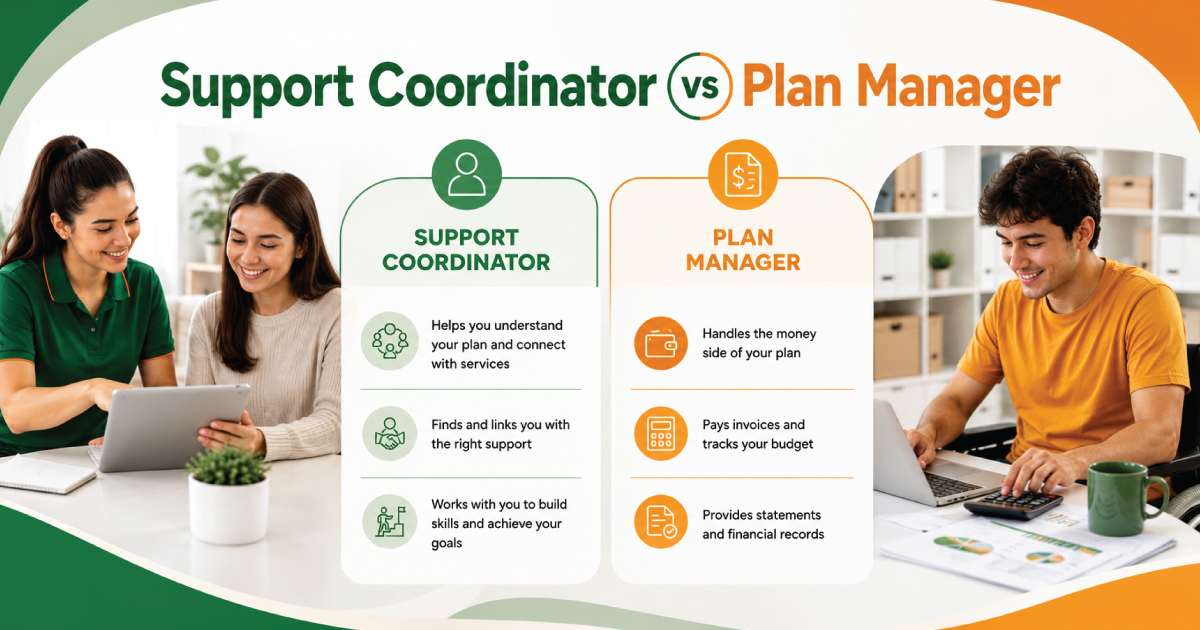
This is the most common mix-up in the whole scheme. The two roles barely overlap.
| Support Coordinator | Plan Manager | |
|---|---|---|
| Main job | Helps you understand your plan and connect with services | Handles the money side of your plan |
| Typical tasks | Finding providers, setting up service agreements, sorting out problems | Paying invoices, tracking your budget, sending statements |
| Where the funding sits | Capacity building budget | Funded separately, doesn’t reduce your other supports |
| In your plan? | Only if you have funding for it | Only if you have funding for it |
Some participants have both. Some have one. Some have neither. It comes down to what’s written into your plan. Our guide to plan-managed vs self-managed NDIS funding breaks down the management side in more detail.
What’s Changing in 2028?
Support coordination is heading for its biggest shake-up since the scheme began. The Australian Government plans to replace the current open-market model with a commissioned model from 1 July 2028, meaning participants would choose from a panel of vetted providers rather than the open market.
Registration rules are shifting alongside it. Mandatory registration for standard support coordinators (registration group 0106) is currently paused while the government works through the broader reform. Specialist support coordinators (group 0132) already have to hold registration, and that hasn’t changed.
Nothing has changed for participants yet, and 2028 is a long way off. But if you’re choosing a coordinator now, it’s fair to ask how they’re preparing. For a wider view of what’s shifting, see our article on NDIS funding changes in 2026.
How Does This Fit With Your Everyday Services?
Once someone has helped you make sense of your plan, the next step is lining up the actual day-to-day support. That might mean personal care, household tasks, community nursing, transport, or social and community participation.
Virtuous Care Services delivers those everyday supports across Bunbury and the wider South West WA region, helping people live more independently at home and in their community. Already working with a support coordinator? They can arrange services with us directly. No coordinator? Our team is happy to talk it through with you anyway. Send a referral or browse our full range of services.
How Do You Arrange Support Coordination?
You can ask for support coordination funding in your plan if you’d like to work with a coordinator. Raise it at your planning meeting with your NDIA planner or my NDIS contact.
Already have the funding? Choose a provider you’d like to work with. Talk to two or three before you decide, because you’ll be working closely with whoever you pick. Ask how quickly they respond, how many participants they carry, and how they handle things when a service falls over.
Not sure whether your plan includes this funding? Check your plan document, or bring it up at your next plan meeting. The NDIS guide to support coordinators sets out the official position.
Frequently Asked Questions
What does a support coordinator actually help with?
A support coordinator helps you understand your plan and connects you with the right services. They don’t deliver day-to-day care themselves. They help you find and set up the providers who do, then build your confidence to manage more of it yourself over time.
Do I have to use a support coordinator?
No. You only get one if your plan includes funding for it, and you can ask for that funding at your planning meeting. Many participants run their plan without a coordinator, especially once they’ve built up the confidence to manage it themselves.
What’s the difference between the three levels of support coordination?
Level 1, support connection, helps you understand your plan and connect with community supports. Level 2, support coordination, is more hands-on and builds your skills to direct your own life. Level 3, specialist support coordination, suits people in complex situations who need services to stay consistent through difficult periods.
Is a support coordinator the same as a plan manager?
No. A support coordinator helps you understand your plan and connect with services. A plan manager looks after the financial side, paying providers and tracking your budget. The NDIS treats them as separate supports, and some participants have both.
What’s the difference between a support coordinator and a local area coordinator?
A local area coordinator is often your first contact with the scheme, offering general information and community connections at no cost to your plan. A support coordinator is funded in your specific plan and works with you in a more hands-on, ongoing way.
Do support coordinators have to be NDIS registered?
Not currently. Support coordinators can be registered or unregistered providers, and mandatory registration for standard support coordinators is paused while the government works through wider reform. Specialist support coordinators do have to hold registration.
Is support coordination being changed or removed?
Not removed, but it is changing. The Australian Government plans to move support coordination to a commissioned model from 1 July 2028, where participants choose from a panel of vetted providers. Nothing changes for participants before then.
Where to Go From Here
The right guidance makes a real difference when your plan feels hard to work through, or when you’re juggling several providers at once. It’s not for everyone, and there’s no shame in managing without it.
Looking for a provider for personal care, household tasks, community nursing, or other everyday disability support in the South West? Contact our team and we’ll talk you through what suits your plan.
